




StudyTEFL provides TEFL training online for those who realise paying more for TEFL training is unnecessary and paying less means lower quality: we’ve found the right blend between quality and price.
Though we use instant feedback quizzes, we support your learning with practice quizzes that explain answers, and we have developed cognitive-practical scenario-based TEFL training to put theory into reflective practice.
Though our content is clear, clean, and automated, we’re here to support you through your TEFL certification training. You can get TEFL certified with peace of mind: we don’t leave you hanging for hours and hours like other cheap TEFL providers.
Staring at office walls wondering if life offers more than spreadsheets and leftovers? Teaching English abroad might be your answer. Not the romanticized Instagram version—the actual job where you get paid to live in another country, experience a different culture daily, and help people master one of the world’s most confusing languages.
This is work. Real work. But it’s work that happens in Vietnam, Spain, South Korea, or Costa Rica instead of a gray cubicle. You’ll teach actual classes, deal with visa paperwork, navigate cultural differences, and figure out how to explain why “read” and “read” are spelled the same but pronounced differently.
The good news? You don’t need a teaching degree or years of classroom experience. You need fluent English, proper certification, and realistic expectations about what teaching abroad actually involves.
What Teaching English Abroad Actually Means
You’re teaching English to non-native speakers. Sometimes that’s helping Japanese businesspeople practice presentations. Sometimes it’s explaining grammar to Italian teenagers who’d rather be on their phones. Sometimes it’s teaching alphabet basics to young kids in Thailand.
The work varies by country, school type, and student age. What stays constant: you need Teaching English as a Foreign Language (TEFL) certification to do it legally and competently.
Why TEFL Certification Matters (And What It Actually Costs)
Most countries require TEFL certification for work visas. Even where it’s not legally mandatory, decent schools won’t hire you without it. The certification proves you understand teaching methodology, classroom management, and how people actually learn languages—not just that you speak English.
Here’s what you need to know about getting certified:
120 hours is the industry standard. Some schools accept less, but you’re limiting your options and honestly, you need those hours to actually know what you’re doing in a classroom.
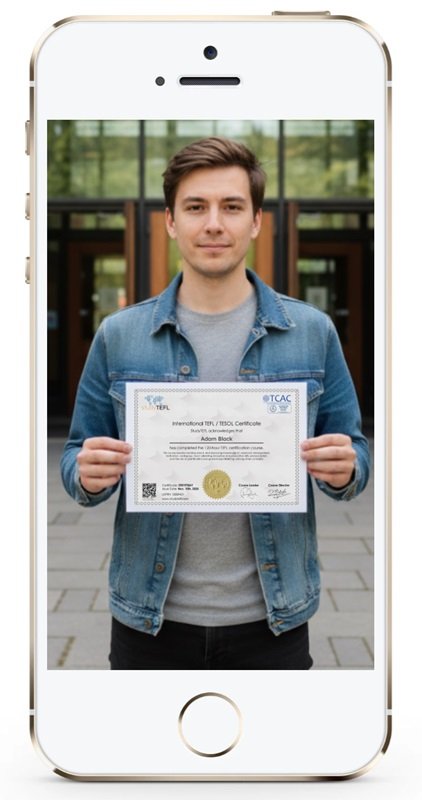
Our accredited 120-hour TEFL course costs $39, or $49 with QR-verified certification that schools can instantly authenticate online. That’s less than dinner and drinks in most cities. Per hour it’s less than $0.50 of quality, accredited learning. When you include the idea of support from trained teachers who can command up to $100/hour for private tuition, not to mention the lifelong-validity certificate(s), it’s an incredible opportunity.
If you want better positions or plan to teach long-term, 168-hour certification gives you an edge. More training means better classroom skills and stronger applications. If you’re thinking of teaching young children, this is recommended also.
Our 168-hour course runs $54, or $64 with QR verification. Still cheaper than a weekend activity, and it opens doors to higher-paying positions.
Yes. Schools check. It shows that a course is high quality enough to meet standards set by other professionals.
StudyTEFL holds dual accreditation and UK government registration (UKRLP). Our certificates include 24/7 online verification, so employers anywhere can confirm your certification instantly. Certification from us means that you’re taught by professional teachers who are trained and certified teachers who’ve actually worked abroad, and still work abroad as teachers: not marketing people who think TEFL certification is just an easy cash cow.
Quality courses cover grammar and teaching methodology, lesson planning and classroom management, how different age groups learn, activities and exercises that actually work, and handling problems like disruptive students or mixed-level classes.
A low-quality cheap TEFL course will just lecture at you. Good courses (like ours) do this to a degree (because there has to be theoretical input) but also give you cognitive-practical skills, realistic scenarios, and teaching flows you’ll actually use when you’re standing in front of 30 students wondering why you thought this was a good idea.
You could, but you shouldn’t. Regular teaching degrees don’t cover teaching English as a foreign language – the methodology is different. Plus, many visa requirements specifically ask for TEFL certification regardless of other credentials.
For $39-64, it’s not worth risking visa problems or classroom struggles (e.g. with grammar or approach differentces, etc.).


Salaries are lower than Asia or the Middle East, but you’re in Europe. Weekend trips to different countries. Deep cultural immersion. Better work-life balance in many places.
Spain, Italy, Czech Republic, Poland, and Portugal hire regularly. Private language schools are the main employers. You’ll need to be comfortable hustling a bit – many teachers work for multiple schools to make full-time income.
Because lifestyle matters. Warm weather, lower cost of living, proximity to beaches or mountains, and students who generally enjoy learning English.
Mexico, Costa Rica, Colombia, Argentina, and Chile are popular. Salaries are modest, but so is rent. You won’t save much, but you’ll live well.
Higher salaries. Tax-free income in UAE and Saudi Arabia. Contracts including housing, flights, and health insurance. Serious savings potential if you’re strategic.
The tradeoff: stricter cultural norms, especially regarding alcohol, dress codes, and relationships. It’s not for everyone, but teachers who thrive there can pay off student loans in a year or two.
Different regions offer completely different experiences. Choose based on what you actually want, not what looks good in photos.
What’s Teaching in Asia Really Like?
High demand, good salaries, strong savings potential if you’re not spending everything on travel and street food. South Korea, Japan, China, Vietnam, and Thailand employ thousands of English teachers.
Students range from highly motivated to completely uninterested (just like anywhere else). Class sizes vary. Cultural differences are real—what works in your home country might flop there.
Contracts typically include housing or housing allowances, airfare reimbursement, and health insurance. Teaching hours run 20-40 weekly depending on the school.
We use scenario-based and task-based activities to help you practically apply the knowledge you've learned in imagined classroom scenarios.
We've modernized our systems: we no longer ask for essays or assignments, but instead assess understanding via quizzes and interactive tasks.
Our text is teacher-made, but we have harnessed the speed of A.I. in making some avatar videos. This helps us keep costs lower and replace content easier.
Job hunting abroad requires more caution than applying to local positions. Scams exist. So do legitimate opportunities. We provide TEFL job recruiter links rather than job listings. Let us deal with what we’re experts in: TEFL. Let recruiters deal with what they’re best at: finding teachers jobs.
Our TEFL job recruiters board lists numerous positions abroad and online. We vet recruiter listings often and regularly add new opportunities as part of ongoing improvements. however, you need to do due diligence yourself.
Reputable recruitment agencies handle placement logistics – visa support, contract negotiation, pre-departure prep. Good agencies make life easier. Bad agencies create headaches. Research thoroughly and read reviews from actual teachers.
School websites directly hiring often post openings. Government programs like EPIK (South Korea) or JET (Japan) offer structured placements with clear terms.
Requesting money upfront (legitimate schools never charge teachers), vague contract terms or refusing to provide written contracts, promises that sound unrealistic (like $5,000 monthly for 10 hours weekly), and lack of information about housing, visa support, or working conditions.
Trust your instincts. If something feels off, it probably is. Ask questions on forums like Reddit or DavesESLcafe. If you’re not happy with terms, don’t take the job.
Most schools hire 2-3 months before start dates. Asian schools often hire for terms starting in February/March or August/September. European schools hire year-round but peak hiring happens before academic terms.
Government programs have specific application windows—sometimes 6-8 months before placement.
Start applications early, but don’t quit your job until you’ve signed a contract and received visa approval.



Though countries and schools differ in their approach, foreign teachers who have signed contracts are now the schools’ assets, so of course they want to make sure you’re taken care of and arrive as planned. This usually involves securing a visa, which has its own requirements (e.g., criminal records checks) and making sure your flight is booked in good time. Some countries require less time and paperwork than others, but recruiters and schools do generally provide assistance.
Most reputable schools and recruitment agencies handle the heavy lifting for visa processing. They’ll send you a contract and detailed instructions on which documents to gather (degree, TEFL certificate, background check, medical results). Once you submit everything, they process the work visa invitation or sponsorship letter required for your application. Many schools reimburse your flight costs after you complete a certain period (usually 6-12 months), though some pay upfront. They’ll typically specify which airport to fly into and may even book the ticket directly.
Upon arrival, schools usually arrange airport pickup and temporary accommodation for your first few days. They’ll guide you through in-country visa conversion – the process where you enter on a tourist or work authorization, then convert to a full work visa at local immigration offices. This involves accompanying you to appointments, translating if needed, and ensuring you submit correct paperwork. Housing is often provided or arranged, either in teacher apartments or through vetted landlords. Schools handle the lease paperwork and sometimes pay deposits.
What you’re still responsible for: gathering and apostilling your documents before departure, attending any embassy appointments in your home country, showing up with required paperwork for in-country processing, and managing your own travel arrangements if flights aren’t provided upfront. The level of support varies – government programs and larger schools offer comprehensive help, while smaller language academies might give you instructions and expect more independence. Always clarify what’s included before signing your contract.
Landing in a new country with a teaching contract is exciting and overwhelming. The first week involves orientation, finalizing any remaining visa paperwork at immigration offices, finding your apartment, figuring out transportation, locating grocery stores, getting a local SIM card, and probably feeling completely lost despite preparation.
Many countries require in-country visa conversion – you enter on a tourist or business visa, then convert to a work visa after arrival. This means trips to immigration offices, submitting documents (again), getting work permits issued, and waiting days to weeks for processing. Your school typically guides you through this, but you’re responsible for showing up with correct paperwork.
Schools provide some support, but you’re largely figuring things out yourself. This is harder if you don’t speak the local language.
Most teachers report feeling competent around month three. The first month is survival mode – managing classes while adjusting to everything being different. Month two involves less panic. Month three, you’ve developed routines, understand what works with your students, and stopped catastrophizing every small problem. Year two is when you actually feel good at it.
Most teachers complete year-one contracts. Some love it and extend or move to different countries to continue teaching. Some finish the year satisfied and return home. Some struggle but stick it out because leaving early means paying back airfare and housing costs. A small percentage leave early because they’re miserable, homesick, or dealing with health issues. This is why realistic expectations matter.
Most people with English ability can stand in front of students and speak English. Not everyone can actually teach it effectively. It sounds easy enough, but without proper training you miss out on so many skills and solutions to issues that you wouldn’t ever be able to imagine exist in lessons and specific learning situations.
Understanding how language acquisition actually works. Knowing multiple ways to explain the same concept. Reading a room and adjusting your approach. Managing classrooms without losing control or killing enthusiasm. Planning lessons that actually accomplish learning goals.
Quality TEFL training teaches these skills. Poor training or no training leaves you floundering when students don’t understand and you can’t figure out why.
We’re taught by professional teachers who live and work abroad. not marketing people who think in terms of profit. Our courses include cognitive-practical activities that actually make your apply the theory in teaching scenarios: most online TEFL courses (especially cheap TESOL) simply give you the information and quiz you on it. We go further and make you think and apply in imagined situations. These realistic classroom scenarios force you to practice handling problems before they happen in front of real students.
Our certification includes 24/7 QR verification, so employers anywhere can instantly confirm legitimacy. Even regular courses with no QR can be verified by our staff on request of employers (they just need to wait up to 48 hours for a response, whereas QR is 24/7 and instant). We’re dual-accredited and registered with UK government authorities (UKRLP). Quality doesn’t require expensive prices – our 120-hour course is $39-$49, and 168 hours is $54-$64. Both include lifetime text material access and job recruiter links.
Sometimes no. Sometimes yes. Cheap courses from unaccredited providers with no teaching experience behind them are worthless. Cheap courses from qualified educators who keep costs low by operating online efficiently – like us – give you legitimate skills without the markup. Most cheap TESOL course providers give you around 12 units of information of 20-30 pages of text (including images, so the content knowledge is actually very thin), a couple of supplementary videos, and 20-30 quiz questions per unit. They’ll also give you a final exam with 50-100 review questions.
StudyTEFL training goes much more in-depth. We have over 24 units of knowledge in our 120-hour online TEFL course. We include practice quizzes; full avatar video coverage of all text (which is around 35 pages per unit: full of useful teaching theory, guidance, tips, and how to apply them in a practical sense); cognitive-practical scenario tasks to apply theory; numerous supplementary videos; model teaching videos of real ESL lessons for different age-groups; and our unit quizzes are much more varied than other cheap courses and high-quality TEFL courses. We care. We don’t just hand out easy TEFL certification. Instead, we provide simple TEFL training that can be easily understood but goes way beyond the basics.
If you’re not interested in our TEFL because it’s too in-depth for you or the extra few dollars in price puts you off, that’s absolutely your choice; however, we encourage you to check accreditation, read reviews from actual graduates, verify instructor credentials, and look at what’s included in the curriculum of the TEFL course you are considering. While other affordable TESOL certification is accepted globally also, our experience with other courses and their weak or thin materials makes us aware of how underprepared it can leave new teachers. Please do your homework and research carefully.
Every idea that's written in text is also available in video. Cheap TEFL certification isn't supposed to offer quality - yet ours does. We also offer supplementary videos to deepen knowledge.
$39 includes a digital certificate (verify by email). Pay $10 more for 1) QR-code embedding plus foil-seal; 2) QR-code but no foil-seal (can self-print); and 3) QR- code on transcipts. All beautiful and emailed. QR is verified instantly 24/7..
Our courses may be automated, but that doesn't mean you won't have questions or (unfortunately) bumps along the way. We're here to support you through your learning. Email break from 4pm GMT to 11pm GMT.
Yes, we’re legit. We’ve just managed to cut overheads. Want to know more? Click here.
Our affordable TEFL certification courses are fully online, so you don’t have to wait around for essays to be marked or worry about tutors not working on weekends or national holidays. With the emergence of A.I., we found that fewer essays and lesson plans were being originally written anyway – that’s not to say that all students weren’t doing their own work, but the temptation was always there). Instead, we have decided to measure understanding using user-friendly quizzes and lesson flows.
We offer you the best cheap TEFL courses online with dual-accreditation and openness about who it is you’re actually dealing with. How many accredited TEFL programs with cheap pricing actually provide names and transparency through memberships or registration details with government branches such as UKRLP? StudyTEFL is provides this information because we are directed and staffed by real, active teachers. Our company has now been running longer than five years, and we are beginning to really establish ourselves in the education world.
Additionally, we are open with you about why we offer such cheap TEFL courses: because we can offer them this cheap and because it is impossible to compete with other TEFL providers in terms of advertising budget and established SEO networking (to feature high in search engine outputs, companies usually invest large amounts of money in programming search engine optimization – SEO – and/or pay dearly to advertise on such engines and other websites). Instead, we focus on providing low prices and quality content that we continue to develop and evolve over time. Our I.T. is mostly performed by a small company, though we are able to deal with many technical issues locally (quickly).
No. Believe it or not, smaller companies are very often the best overall value for customers for a number of reasons. We provide the best TEFL certification online (per dollar spent) because we are passionate educators, but also because if we didn’t then we wouldn’t last very long in this highly competitive industry. If we didn’t provide the services that we claim to provide, you’d read about it in reviews. If we took a long time to respond to students’ queries, you’d experience that yourself when asking us questions and/or you’d, again, read about it in reviews.
Small companies offer more personalized customer service: we have smaller staff numbers, which means we can actually communicate with one another about specific students and save you time and hassle. What’s more, we have to try much, much harder to convince our potential students that we are what we say we are, so that is reflected in the lower price and bonus material, for example. When you take a studyTEFL course, you get affordable TEFL certification but you also get accredited TEFL certification, verifiable TEFL certificates with embedded QR-codes (or email verification within 48 hours when an inquiry is made), lifetime text access, and much more, because we want you to love learning with us and because you likely wouldn’t choose us if we didn’t go that extra mile.