120-Hour Practical TEFL Course with Feedback $69

StudyTEFL is the best cheap TEFL course provider because we give you practical teaching opportunities.

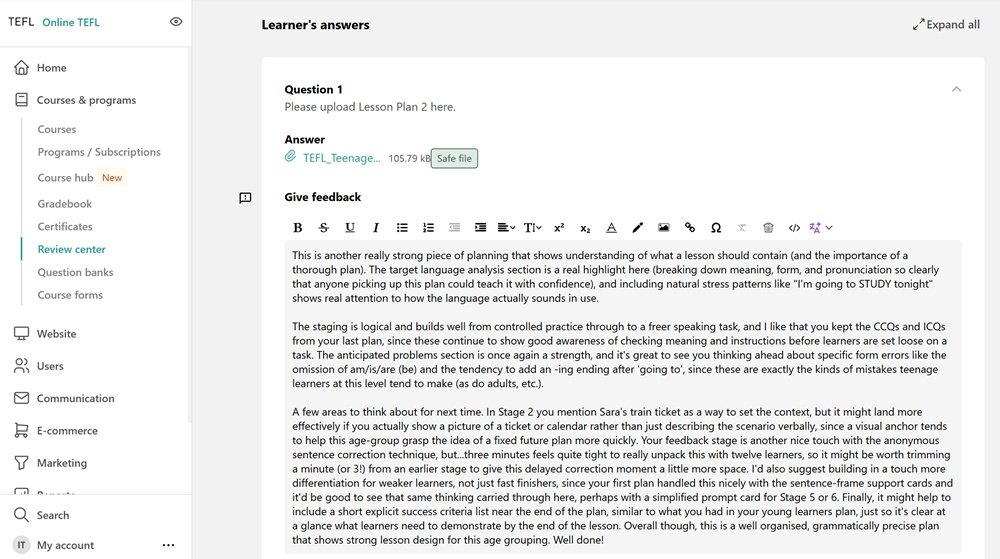
Our Practical TEFL Feedback Option gives online TEFL trainees the opportunity to receive tutor feedback on real teaching-related tasks. It is designed for learners who want more than a self-paced TEFL certificate and would like practical guidance on lesson planning, lesson delivery, classroom techniques, and to strengthen their teaching confidence.

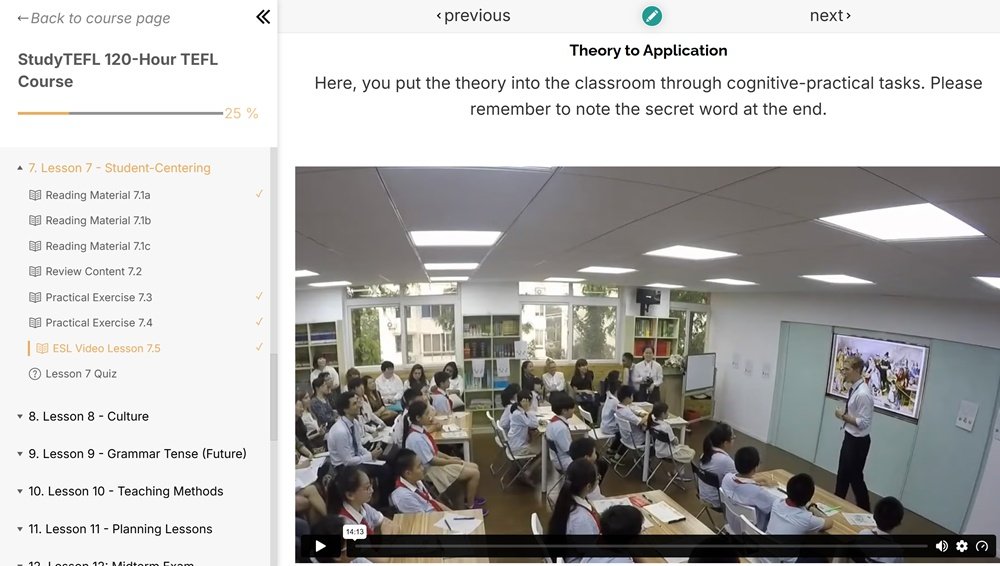
This special practical-focused course is still an affordable TEFL course, but it’s suitable for new English teachers, online ESL tutors, and TEFL trainees who want to practice applying course theory to realistic teaching situations while still benefitting from learning the key content through our cognitive-practical tasks and real ESL lesson videos.

At the end of the course, your TEFL-TESOL certificate will read “Certificate in Teaching English as a Foreign Language with Assessed Lesson Planning and Demo Teaching.”

Why Add Practical TEFL Feedback?

Learn Everything in Our Regular 120-Hour TEFL Course

Submit 2 Lesson Plans - Get Tutor Feedback

Record 2 x 15-Minute Demo Lessons - Get Tutor Feedback

Many online TEFL courses are fully self-paced and assessment-based. Our standard courses take theory into practice via lesson flow scenario tasks, but some learners also want the chance to go through the actual process of planning and delivering a lesson before applying for teaching work.

This special practical course bridges that gap by giving you feedback on how you plan, structure, and present a lesson. It helps you move beyond thinking like a teacher (which is still better than most courses encourage) and encourages you to physically behave like a teacher.

The Cheapest Practical TEFL Course Online: $39-$69

One of the challenges in the TEFL industry is showing that an affordable TEFL course can still be structured, practical, and useful. A higher price doesn’t always mean better training, and a lower price doesn’t have to mean low quality.

Many online TEFL courses rely heavily on passive reading and basic multiple-choice recall questions. Our aim is different. We want learners to engage with the material, apply TEFL concepts, and think through classroom decisions. That’s what our regular course does.

However, we realized it could be made even more practical by making the final assessment be based on trainees practising the skills all new English teachers need to work on: lesson planning and actually teaching.

That’s why we created the 120-Hour Practical TEFL Course with Feedback.

OTCAC-logo-orange-e1775319391161

TEFL Course Accreditation

We entrust our course accreditation to OTCAC, an independent accreditor who we trust to guide us to the best solutions for meeting the rigorous demands of the profession. Their standards and pricing are open and public, enabling credibility.

studytefl cpd 1

Course Provider Accreditation

In the past, we have worked with other CPD accreditors, such as CPD Group. Currently, we are accredited by CPD-verified: their practices and framework align more with our principles.

UK Government-Registered

We are registered as an official learning provider with the UK government UKRLP. We're trustworthy and legitimate as an online traning course provider.

Notarize & Apostille

StudyTEFL TEFL-TESOL certificates can be notarized and apostilled for use abroad. We have partnered with Apostille.org.uk for a special rate.

120-Hour TEFL Course Curriculum

Explore the full TEFL syllabus below. Each lesson introduces practical teaching concepts, classroom strategies, and language awareness needed for confident English teaching across a range of contexts.

Summary

This lesson introduces the field of Teaching English as a Foreign Language and provides a broad view of the profession. It explores common teaching contexts, learner profiles, and the foundational principles that shape successful TEFL practice.

Learning Objectives
  • Explain what TEFL is and where it is commonly practiced.
  • Recognize different learner types and teaching environments.
  • Describe the core responsibilities of an English teacher.
  • Identify key expectations in professional TEFL settings.
  • Understand how context influences teaching choices.
  • Reflect on possible pathways into TEFL work.
Summary

This lesson develops grammatical awareness through the core parts of speech in English. It prepares trainees to identify language form accurately and explain it more clearly in teaching situations.

Learning Objectives
  • Identify the main parts of speech in English.
  • Explain how words function within sentences.
  • Distinguish between form, meaning, and use.
  • Recognize common learner confusion related to word classes.
  • Use grammar awareness to support lesson delivery.
  • Present language points more clearly to learners.
Summary

This lesson focuses on the nature of ESL teaching and the practical realities of helping learners build communicative ability. It examines teacher responsibilities, learner needs, and the importance of clarity, patience, and adaptability.

Learning Objectives
  • Describe the aims of ESL teaching in practical settings.
  • Recognize the teacher’s role in supporting communication.
  • Identify common challenges language learners face.
  • Adapt explanations for learners with different proficiency levels.
  • Balance language accuracy with confidence-building.
  • Use supportive teaching behavior to encourage progress.
Summary

This lesson examines how teachers create an organized, focused, and positive classroom environment. It covers routines, instructions, pacing, grouping, and behavior management strategies that support effective learning.

Learning Objectives
  • Establish clear routines and expectations.
  • Give concise and effective classroom instructions.
  • Use transitions and pacing to maintain lesson flow.
  • Manage pair work and group work productively.
  • Respond appropriately to common behavior issues.
  • Create a structured but supportive classroom atmosphere.
Summary

This lesson explores the present tense system and how to teach it through meaning, form, and context. It focuses on helping learners understand habitual action, current activity, and ongoing states.

Learning Objectives
  • Differentiate key present tense forms and uses.
  • Teach present language through examples and context.
  • Clarify distinctions between routine and current action.
  • Identify common learner errors with present forms.
  • Use timelines and concept questions effectively.
  • Create meaningful practice activities for present tenses.
Summary

This lesson examines what helps learners engage with language study and remain committed over time. It looks at confidence, goal-setting, classroom atmosphere, and the teacher’s role in sustaining effort.

Learning Objectives
  • Explain factors that influence learner motivation.
  • Differentiate intrinsic and extrinsic motivation.
  • Create a classroom climate that supports participation.
  • Use encouragement and feedback productively.
  • Set achievable goals that promote progress.
  • Respond constructively to disengagement.
Summary

This lesson introduces classroom approaches that place learner participation and independence at the center of teaching. It encourages a shift from teacher-dominated instruction to active student use of language.

Learning Objectives
  • Define the principles of student-centered teaching.
  • Reduce unnecessary teacher talking time.
  • Increase opportunities for meaningful student interaction.
  • Use tasks that promote autonomy and engagement.
  • Support learners through appropriate scaffolding.
  • Design more participatory classroom activities.
Summary

This lesson looks at the relationship between language, communication, and culture. It helps teachers approach intercultural awareness thoughtfully and build more inclusive classroom practice.

Learning Objectives
  • Explain how culture affects communication.
  • Recognize different classroom expectations across contexts.
  • Teach language with sensitivity to social appropriacy.
  • Avoid simplistic assumptions about cultural groups.
  • Support learners in cross-cultural communication.
  • Develop more inclusive teaching practices.
Summary

This additional present tenses lesson reinforces key distinctions and provides further teaching practice with common present forms. It supports stronger grammar presentation and more confident correction.

Learning Objectives
  • Review the major present tense structures accurately.
  • Compare present simple and present continuous clearly.
  • Teach state and action verbs more effectively.
  • Anticipate frequent learner mistakes.
  • Build practice sequences from controlled to freer use.
  • Strengthen confidence in presenting present-time meaning.
Summary

This lesson surveys major language teaching methods and approaches, showing how they influence classroom practice. It encourages trainees to understand method choices critically rather than follow any single model rigidly.

Learning Objectives
  • Identify major teaching methods used in language education.
  • Compare traditional and communicative approaches.
  • Recognize strengths and limitations of different methods.
  • Select suitable techniques for different lesson aims.
  • Balance fluency and accuracy in teaching decisions.
  • Apply methodology more flexibly in practice.
Summary

This lesson teaches the essentials of building coherent, purposeful lesson plans. It covers lesson aims, sequencing, staging, timing, and choosing activities that support language outcomes.

Learning Objectives
  • Write clear lesson aims and outcomes.
  • Sequence lesson stages logically.
  • Select activities that support specific language goals.
  • Plan timing realistically.
  • Include setup, practice, and feedback stages.
  • Adapt lesson plans to learner level and context.
Summary

The midterm exam reviews the central concepts covered in the first half of the course. It measures progress in grammar awareness, methodology, classroom practice, and lesson planning.

Learning Objectives
  • Demonstrate understanding of core TEFL concepts studied so far.
  • Apply grammar knowledge from earlier units.
  • Show awareness of classroom management principles.
  • Recognize effective planning and teaching choices.
  • Reflect on strengths and improvement areas.
Summary

This lesson covers the major past tense forms and how to teach them clearly through context and contrast. It supports more effective grammar explanation and stronger learner understanding of past-time meaning.

Learning Objectives
  • Differentiate the main past tense forms and uses.
  • Explain completed, ongoing, and earlier past actions.
  • Use timelines and examples to clarify meaning.
  • Identify common learner errors in past tense usage.
  • Teach past forms through guided and communicative practice.
  • Support learners in using past language more accurately.
Summary

This lesson develops awareness of more complex grammar, including structures that often challenge both learners and new teachers. It emphasizes teaching difficult language points in a clear, staged, and manageable way.

Learning Objectives
  • Recognize common advanced grammar structures.
  • Break down complex language into teachable stages.
  • Explain grammar meaning without overcomplicating it.
  • Use examples to clarify form and use.
  • Anticipate likely learner difficulties.
  • Design effective practice for more advanced structures.
Summary

This lesson focuses on how vocabulary can be taught for retention, recognition, and active use. It explores meaning, pronunciation, collocation, recycling, and practical classroom techniques for lexical development.

Learning Objectives
  • Select vocabulary that matches learner needs and level.
  • Teach meaning through context, visuals, and examples.
  • Highlight pronunciation, spelling, and stress.
  • Introduce collocations and lexical sets.
  • Recycle vocabulary to support retention.
  • Create activities that move words into active use.
Summary

This lesson explores how to teach speaking and writing in a structured and supportive way. It focuses on scaffolding, fluency development, task sequencing, and effective correction.

Learning Objectives
  • Differentiate speaking and writing as productive skills.
  • Plan tasks that encourage meaningful language output.
  • Support learners through staged productive work.
  • Use correction appropriately during and after production.
  • Develop confidence as well as accuracy.
  • Assess productive work more effectively.
Summary

This lesson introduces pronunciation teaching as a practical part of communication-focused instruction. It covers sounds, stress, rhythm, and intelligibility, with attention to classroom application.

Learning Objectives
  • Teach pronunciation with intelligibility as the main goal.
  • Recognize key sound and stress features in English.
  • Model target language more clearly.
  • Use drilling and repetition effectively.
  • Identify pronunciation issues that affect understanding.
  • Integrate pronunciation into broader lessons.
Summary

This lesson introduces reading and listening as receptive skills that require strategy and support. It focuses on helping learners process meaning rather than simply complete answers.

Learning Objectives
  • Define reading and listening as receptive language skills.
  • Use pre-, while-, and post-task lesson structure.
  • Activate prior knowledge before a text or recording.
  • Teach gist and detail tasks appropriately.
  • Support learners through staged comprehension work.
  • Link receptive tasks to language development.
Summary

This lesson extends receptive skills teaching by examining sub-skills, task design, and text selection in greater depth. It helps trainees refine how they support comprehension and interpret learner difficulty.

Learning Objectives
  • Teach skimming, scanning, and inference more explicitly.
  • Select texts appropriate to learner level and aims.
  • Support learners with listening challenges such as speed and connected speech.
  • Differentiate intensive and extensive receptive work.
  • Design tasks that build confidence progressively.
  • Diagnose common receptive skill difficulties.
Summary

This lesson examines how teachers measure progress and respond to learner performance. It covers feedback types, assessment purposes, and practical ways to support improvement without discouraging students.

Learning Objectives
  • Differentiate formative and summative assessment.
  • Give feedback that is clear, constructive, and useful.
  • Assess speaking, writing, reading, and listening appropriately.
  • Use simple criteria or rubrics to guide judgment.
  • Support learner progress through ongoing evaluation.
  • Use assessment information to inform future teaching.
Summary

This lesson focuses on the resources and tools that support teaching in physical and digital classrooms. It emphasizes selecting and using equipment in ways that genuinely improve clarity, practice, and engagement.

Learning Objectives
  • Identify common classroom equipment and teaching aids.
  • Use boards, visuals, and handouts effectively.
  • Select resources that match lesson aims.
  • Organize materials efficiently during lessons.
  • Adapt equipment choices across different contexts.
  • Evaluate the usefulness of teaching tools critically.
Summary

This lesson examines the use of games and playful activities as purposeful teaching tools. It focuses on learner engagement, repetition, energy management, and keeping activities aligned with language aims.

Learning Objectives
  • Explain the value of games in language teaching.
  • Select games that support clear lesson objectives.
  • Use competition and collaboration appropriately.
  • Maintain control during high-energy activities.
  • Adapt games to age, level, and class size.
  • Ensure fun activities still produce meaningful practice.
Summary

This lesson prepares teachers to work effectively in virtual classrooms. It covers digital interaction, online lesson structure, platform tools, student engagement, and common challenges in remote teaching.

Learning Objectives
  • Set up and manage an effective online learning environment.
  • Use online teaching tools confidently.
  • Adapt lesson stages for remote delivery.
  • Maintain engagement in virtual classes.
  • Monitor understanding and participation online.
  • Respond to common technical and communication issues.
Summary

This lesson explores how teaching changes across age groups, institutions, class types, and delivery modes. It encourages flexible planning and context-sensitive choices rather than one fixed teaching style.

Learning Objectives
  • Recognize how different teaching contexts shape instruction.
  • Adapt lessons for groups with different goals and needs.
  • Compare online, in-person, private, and group teaching contexts.
  • Adjust materials and tasks for different learner profiles.
  • Make more context-appropriate teaching decisions.
  • Reflect on how flexibility improves teaching effectiveness.
Summary

This lesson looks at practical next steps after training, including job pathways, applications, and professional presentation. It helps trainees prepare to enter the TEFL job market with more confidence and awareness.

Learning Objectives
  • Identify common TEFL employment pathways.
  • Understand what employers typically look for in applicants.
  • Prepare more effectively for job applications.
  • Present qualifications and experience professionally.
  • Recognize the importance of adaptability and professionalism.
  • Plan practical steps toward securing TEFL work.
Summary

The final exam reviews the course as a whole by seeing how well you can apply what's been learned. You need to create 2 lesson plans and then put those plans into action by demonstrating how you would teach it (in a 15-20 minute extract).

Learning Objectives
  • Demonstrate understanding of the full TEFL syllabus.
  • Apply grammar, vocabulary, and methodology knowledge accurately into a working lesson plan.
  • Accept feedback and use it to improve lesson plans.
  • Show awareness of good classroom practice and use it to guide 2 practical demonstrations of good teaching.

Is this Real Teaching Practice?

Yes, this is practical TEFL training with tutor feedback. You will create lesson plans, record demo teaching segments, and receive feedback from a tutor on your planning and teaching delivery.

Is this Equivalent To CELTA?

No, it's important to be clear: this is not live observed teaching practice with real students, and it isn't equivalent to CELTA, DELTA, or an in-person practicum. It is practical and it is useful, though.

Does A Real Teacher Give Feedback?

Yes, a qualified teacher gives you feedback on both lesson plans to help you strengthen them before you turn each of them into a 15-20 minute demo. Feedback will help you skill-build.

How It Works

Not sure how online learning works? Choose a course, pay, login and learn, sit the quizzes and online tasks from a comfortable place, and then check your inbox for your digital TEFL certification.

01

Choose Your TEFL Course

Anyone over 18-years-old with a good standard of English can enroll. Once payment is made, you've enrolled. Login and study.

Step 2

Study TEFL online

Read the material, watch the videos, complete the interactive tasks and quizzes, then complete the practical components. Download the certificate.

Step 3

Apply for TEFL Jobs

Once TEFL certified, you can apply for English teaching jobs. Need your certificate notarized and apostilled? Get a discount through Apostille.org.uk.

We provide high-quality but affordable Online TEFL Certification

Are we perfect? Of course not, but our TEFL courses are just as good as ones costing ten times more. We’re qualified teachers, and we’ve tried quite a few courses between us, so we actually know.

Scroll to Top