
TEFL
Teaching English as a foreign language
Commonly used when learners are studying English in a country where English isn't the main everyday language.
Example: an English teacher working in Thailand or Japan.Multi-currency checkout: USD, GBP, EUR, AUD and CAD.
TEFL and TESOL overlap much more than the names suggest. TEFL usually refers to teaching English as a foreign language, while TESOL is a broader term for teaching English to speakers of other languages.
Neither acronym is a universal quality level. A course called TESOL isn't automatically more advanced than one called TEFL, and a course called TEFL isn't automatically the same as CELTA, Trinity CertTESOL or a regulated teaching qualification. The useful question is what the training actually contains and whether it fits the work you want to do.
The labels describe teaching, learning or professional context. They aren't a neat ranking from basic to advanced.
Commonly used when learners are studying English in a country where English isn't the main everyday language.
Example: an English teacher working in Thailand or Japan.A broad term that can include both foreign-language and second/additional-language teaching contexts.
You'll also see TESOL used in qualification and university programme names.Traditionally used for teaching learners living in a society where English is widely used around them.
Example: English support for migrants in an English-speaking country.A broad professional term covering English teaching without forcing the learner or location into one particular category.
Common in professional and academic English-teaching contexts.This describes the language-learning context rather than the teacher-training qualification.
An EFL learner studies English. A TEFL trainee studies how to teach it.Choose a context below. This is why StudyTEFL uses combined TEFL-TESOL wording rather than pretending the two fields sit in separate boxes.
Teachers working with English learners in countries where English isn't the main everyday language are commonly described as TEFL teachers. Good preparation still involves lesson planning, classroom management, language awareness, skills teaching, assessment and adapting to different learners.
One reason TEFL terminology becomes confusing is that teaching qualifications, English-language tests, classroom methods and professional fields all appear in the same conversations.
The easiest way to understand them is to ask: Is this describing a teacher, a learner, a test, a method or a qualification?

An English-language proficiency test used for study, migration and other purposes. It isn't a teacher-training qualification.
A proficiency test, especially associated with academic admissions. Don't confuse TOEFL with TEFL.
An English test associated particularly with workplace and professional communication.
The same acronym can mean two completely different teaching ideas: how much the teacher talks, or a lesson framework.
English designed around particular learner needs, such as business, aviation, hospitality or technical work.
The field concerned with how additional languages are acquired and learned.
A system of symbols used to represent speech sounds. Teachers may encounter it when studying pronunciation.
A particular British accent. It isn't the same thing as Standard English, and English teachers don't need to sound RP.
A job title used particularly in Japan for teachers assisting or team-teaching in schools.
StudyTEFL courses cover the core knowledge used across TEFL and wider TESOL contexts: lesson planning, grammar and language awareness, classroom management, learner motivation, productive and receptive skills, pronunciation, assessment, online teaching, different teaching contexts and employment preparation.
That's why our certificates use the wording TEFL-TESOL Certificate. We aren't suggesting that two unrelated qualifications have somehow been bundled together. We're recognising the substantial overlap between the fields and the breadth of the course content.
You also don't need to pay for a separate “TESOL upgrade” simply to add another acronym to your certificate.
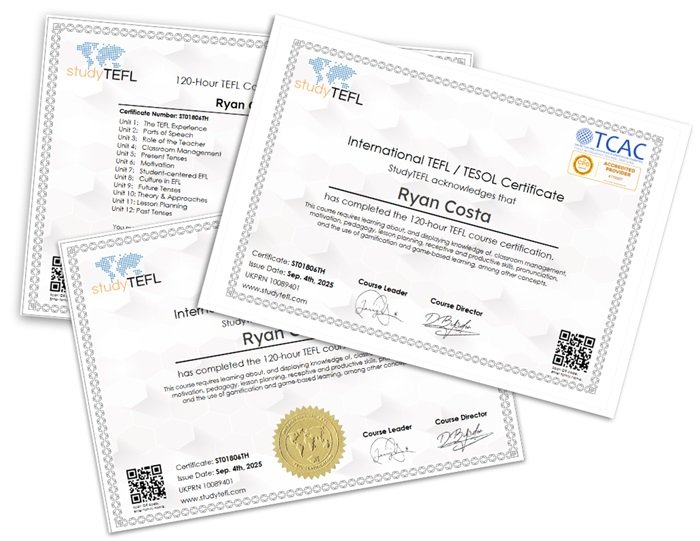
All three current routes sit within the same TEFL-TESOL teaching field. The differences are in course depth, specialist content and practical feedback.
The main all-round StudyTEFL route, with the complete 24-unit core, real classroom observation, scenarios and online-teaching preparation.
Complete TEFL plus dedicated training for young learners and adult learners.
Complete TEFL plus two assessed lesson plans and two recorded demo-teaching tasks with tutor feedback.
Ten quick questions. No timer, no streaks and no tricks. Each answer includes a short explanation.
Use this after reading the page, or just jump in and see which terms you already know.
StudyTEFL uses TEFL-TESOL certification because our courses prepare trainees across overlapping English-teaching contexts. Compare the routes, inspect the curriculum, and choose the level of training that fits your plans.